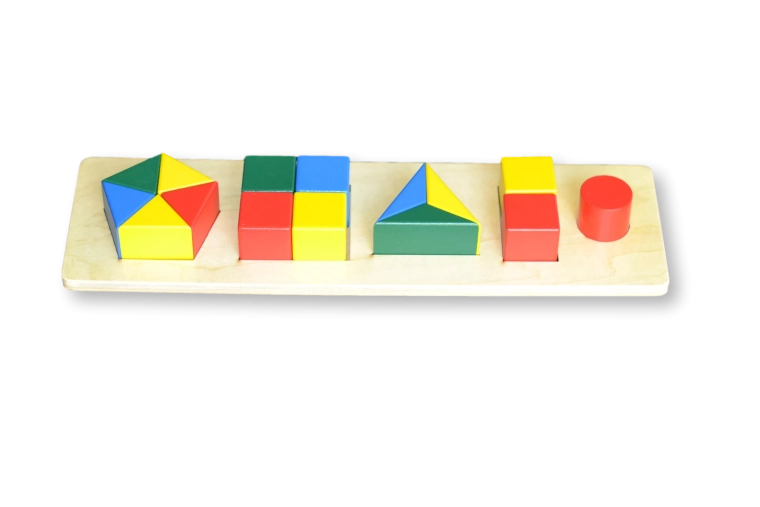
This colorful puzzle activity allows children to discover how individual parts can connect and form one whole – a shape or a picture. Thanks to this, children naturally acquire the basics of spatial perception and learn to work with shapes and their mutual relationships.
Pattern recognition is an important part of mathematical development. While assembling, children practice the problem-solving process and logical thinking, which can also help them later in the development of algebraic thinking. A big advantage is also immediate feedback – the pieces fit only in the correct place, so the child immediately knows whether they chose the right shape.
The game also supports the development of space-related vocabulary. During shared play, parents can naturally use terms such as: inside, outside, flip, turn, bottom, top, long, short, straight, or corner.